




Rooftop Tent Condensation: Why It Happens and How to Prevent It
September 4, 2026

Tent condensation can be an unwelcome surprise when you wake up after a night of camping, reach toward the wall or ceiling of your rooftop tent, and find that it’s wet.
Maybe there are small droplets of water on the fabric. Maybe your bedding feels damp. You lift the mattress and discover moisture underneath it.
The first thought is often: Is my rooftop tent leaking?
In many cases, the answer is no. What you’re seeing is tent condensation, a natural result of moisture in the air coming into contact with cooler surfaces inside your tent.
Condensation can happen in just about any tent, including soft shell and hard shell rooftop tents. It’s especially common during cool nights, humid weather, winter camping, and other conditions where there’s a significant difference between the temperature inside your tent and the temperature outside.
While you may not be able to completely eliminate tent condensation, understanding why it happens makes it much easier to manage.
In this guide, we’ll explain what causes condensation inside a tent, why rooftop tents experience it, how to reduce it, what to do about moisture underneath your mattress, and how to tell the difference between normal condensation and a possible water leak.
Why Is My Rooftop Tent Wet Inside?
If the inside of your rooftop tent is wet when you wake up, water doesn’t necessarily have to be getting into the tent from outside.
Some of that water may have started the night inside the tent with you.
Every time you breathe, moisture enters the surrounding air. Your body also releases moisture through perspiration. Add another camper, wet clothing, damp bedding, boots, pets, or humid outside air and the amount of moisture inside a relatively small sleeping space can increase quickly.
During the night, the surfaces of your rooftop tent are exposed to cooler outside temperatures. As warm, moisture-laden air inside the tent encounters those colder surfaces, it cools.
Once that air cools sufficiently, it can no longer hold the same amount of water vapor. The excess moisture changes from water vapor into liquid water on the cooler surface.
That’s condensation.
It’s the same basic process that causes water droplets to form on the outside of a cold drink on a warm day.
Inside a rooftop tent, those droplets can form on the walls, ceiling, windows, hardware, tent base, or underneath the mattress.
What Causes Condensation Inside a Tent?
Tent condensation requires three basic ingredients:
Moisture + warm air + a cold enough surface.
The temperature at which air becomes saturated and water vapor begins condensing is known as the dew point.
You don’t need to calculate the dew point every time you go camping, but understanding the concept helps explain why condensation can seem unpredictable.
Imagine two people sleeping inside a rooftop tent. Their bodies and breathing gradually warm the air and add moisture to it. Meanwhile, the outside temperature drops throughout the night, cooling the tent fabric, shell, windows and base.
Eventually, some of those surfaces can become cold enough for moisture in the warmer interior air to condense against them.
The greater the combination of interior humidity and cold surfaces, the greater the potential for condensation.
Where Does the Moisture Inside a Tent Come From?
Some moisture comes from the surrounding environment, but campers themselves can be a significant source.
Every breath releases moisture into the air inside the tent.
Your body continues releasing moisture while you sleep.
Wet or humid clothing adds additional moisture to the enclosed space.
Outdoor equipment can carry rain, snow and moisture into the tent.
Wet towels continue releasing moisture as they dry.
Damp blankets, sleeping bags and pillows can increase interior humidity.
Pets add body heat and moisture to the sleeping area just like people do.
Water carried inside on people or gear can increase moisture levels.
Naturally humid air can enter the tent and contribute to condensation.
This is why you can experience condensation even when it hasn’t rained.
A perfectly waterproof tent can still be wet inside the next morning because waterproofing and condensation are two different issues.
Waterproofing is intended to keep external water from entering the tent. Condensation originates from water vapor already present in the air.
Why Do Rooftop Tents Get Condensation?
Rooftop tents aren’t exempt from the same physical process that creates condensation in ground tents, campers, vehicles and other enclosed sleeping spaces.
In fact, a rooftop tent creates a very easy-to-understand condensation environment.
You have one or more people sleeping inside a relatively compact space, continually adding heat and moisture to the air. At the same time, the tent is elevated above the ground and exposed to the surrounding air.
The roof, walls, windows, shell and tent base can all become cold overnight.
Warm, humid interior air then encounters those cooler surfaces.
If the surfaces are below the dew point of the surrounding air, moisture can condense on them.
The amount of condensation you experience can change dramatically from one camping trip to another because temperature, humidity, wind, elevation, weather, campsite location, ventilation and the number of occupants all affect the conditions inside the tent.
You could camp in the same rooftop tent for several nights without noticing much condensation and then experience considerably more during a cold or humid night.
That doesn’t necessarily mean anything suddenly went wrong with your tent.
The conditions changed.
Why Is Tent Condensation Worse in Cold Weather?
Condensation often becomes more noticeable when temperatures drop because the surfaces of your rooftop tent cool much faster than the warm, moisture-filled air inside.
Warm Moist Air Builds Up
Breathing, perspiration, damp gear and normal humidity add water vapor to the air inside the tent.
Tent Surfaces Get Cold
The roof, walls, windows and tent base cool as outside temperatures fall, creating colder interior surfaces.
Moisture Condenses
When humid interior air contacts a surface cold enough to reach the dew point, water vapor turns into liquid droplets.
Closing every vent to stay warmer can trap even more moisture inside. In cold weather, maintaining some controlled ventilation is especially important.
How to Prevent Condensation in a Rooftop Tent
It’s more accurate to talk about reducing and managing condensation than completely preventing it.
Temperature and humidity are environmental variables you don’t always control. What you can control is how much additional moisture you introduce into the tent and how effectively that moisture can escape.
1. Ventilate Your Rooftop Tent
Ventilation is one of the most effective tools for managing tent condensation.
Opening available vents or partially opening windows allows warm, humid air to escape rather than continuously accumulating inside the tent.
It may be tempting to close everything tightly during a cold night, but a completely sealed sleeping space can trap the moisture produced by its occupants.
Use your rooftop tent’s ventilation features whenever conditions allow.
2. Create Cross-Ventilation
Opening a single vent helps, but airflow is generally more effective when air has both an entrance and an exit.
Opening vents or windows on opposite sides of the tent can encourage air to move through the interior rather than simply exchanging air through one opening.
Even relatively small openings can help establish airflow.
You don’t necessarily need every window completely open. The goal is to create enough ventilation for moisture-laden air to escape while maintaining a comfortable sleeping environment.
3. Keep Wet Gear Out of the Sleeping Area
Everything wet that enters your tent introduces additional moisture.
If possible, avoid bringing wet boots, jackets, towels and other damp equipment into the main sleeping area.
If wet gear must come inside because of weather or campsite conditions, isolate it from your bedding and maximize ventilation.
The same applies to snow.
Knock snow from clothing and gear before climbing into the tent rather than allowing it to melt inside.
4. Don’t Go to Bed With Damp Bedding
Moisture doesn’t have to be dripping wet to contribute to interior humidity.
If sleeping bags, blankets, pillows or clothing became damp during the day, air them out when conditions allow before settling in for the night.
This becomes especially important during multi-day trips when small amounts of moisture can accumulate in your sleeping system over time.
5. Use Your Tent’s Ventilation Even When It’s Cold
One of the easiest condensation mistakes is closing every available vent because the temperature has dropped.
Instead, experiment with maintaining some airflow throughout the night.
A small amount of strategically placed ventilation can help release humid air without exposing the entire interior to wind.
Your exact setup will depend on the tent, weather and wind direction, but the principle remains the same:
Don’t trap all of the moisture you’re producing inside the tent.
6. Air Out the Tent When Conditions Allow
Morning is an excellent opportunity to remove moisture that accumulated overnight.
Open doors and windows. Allow fresh air to circulate through the tent. Pull bedding back so trapped moisture can escape.
If the weather is dry and you have time before breaking camp, allowing the tent to remain open can make a substantial difference.
Why Does Condensation Form Under a Rooftop Tent Mattress?
Condensation underneath a mattress deserves special attention because it isn’t always immediately visible.
You might wake up to relatively dry walls and still discover moisture when you lift the mattress.
The bottom of a rooftop tent is directly exposed to outside temperatures and can become quite cold overnight. Meanwhile, the mattress and occupants above it remain comparatively warm.
That temperature difference, combined with moisture and limited airflow underneath the mattress, can create favorable conditions for condensation.
Unlike the walls or ceiling, the space between a mattress and the tent base may receive very little airflow.
Moisture that forms there can therefore take longer to evaporate.
This is why it’s a good habit to periodically lift or check underneath your rooftop tent mattress, particularly after cold or humid nights and during extended trips.
How Does an Anti-Condensation Mat Help?
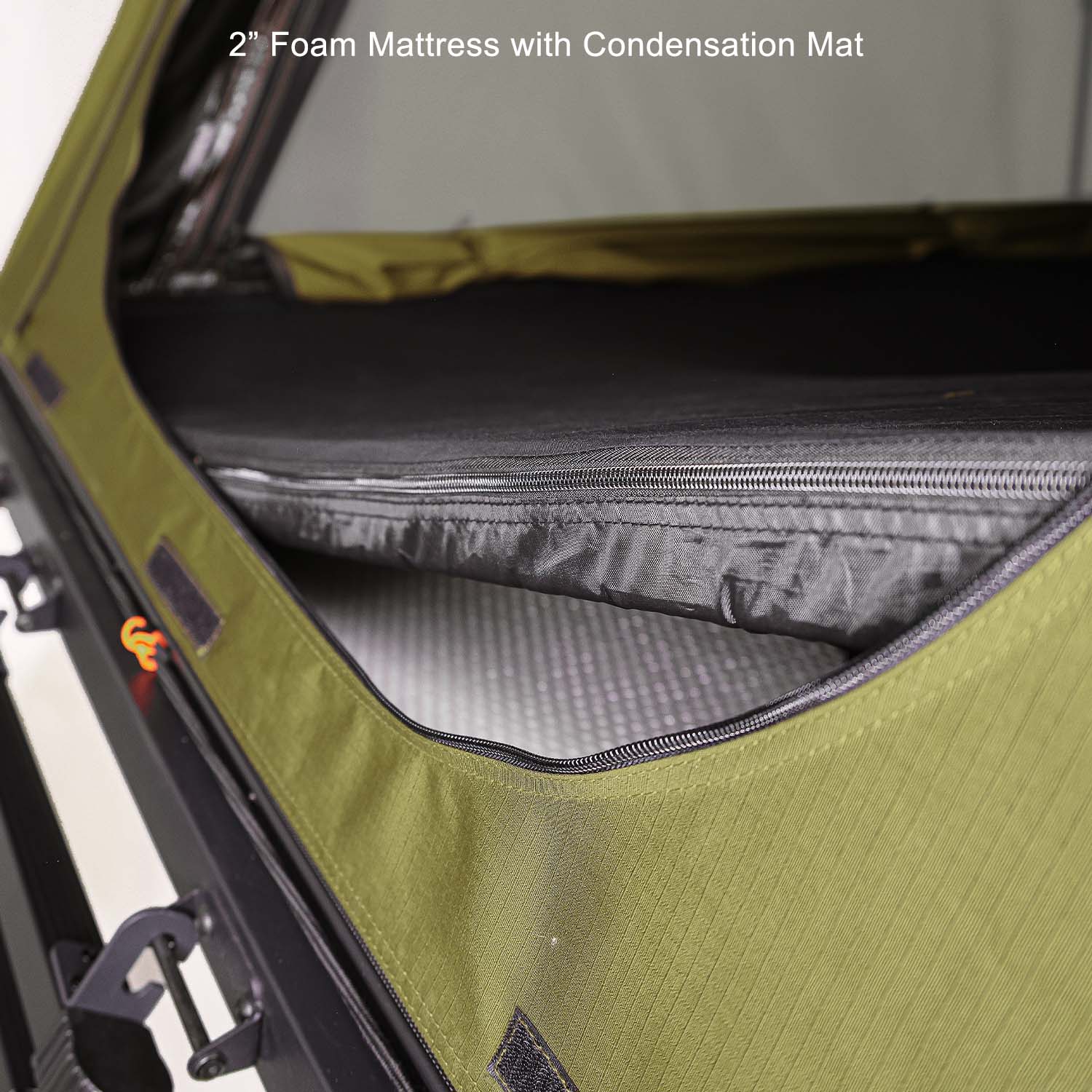
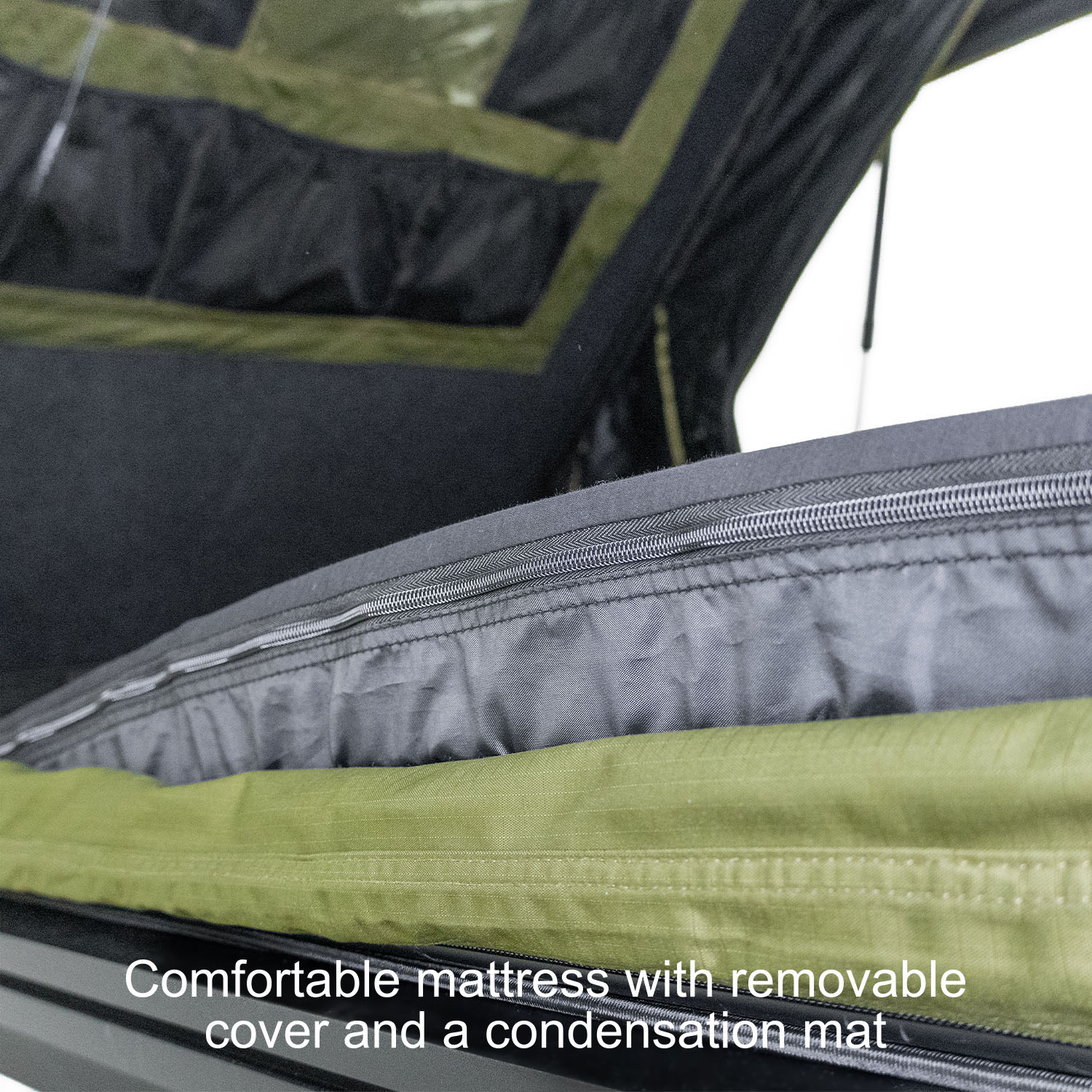
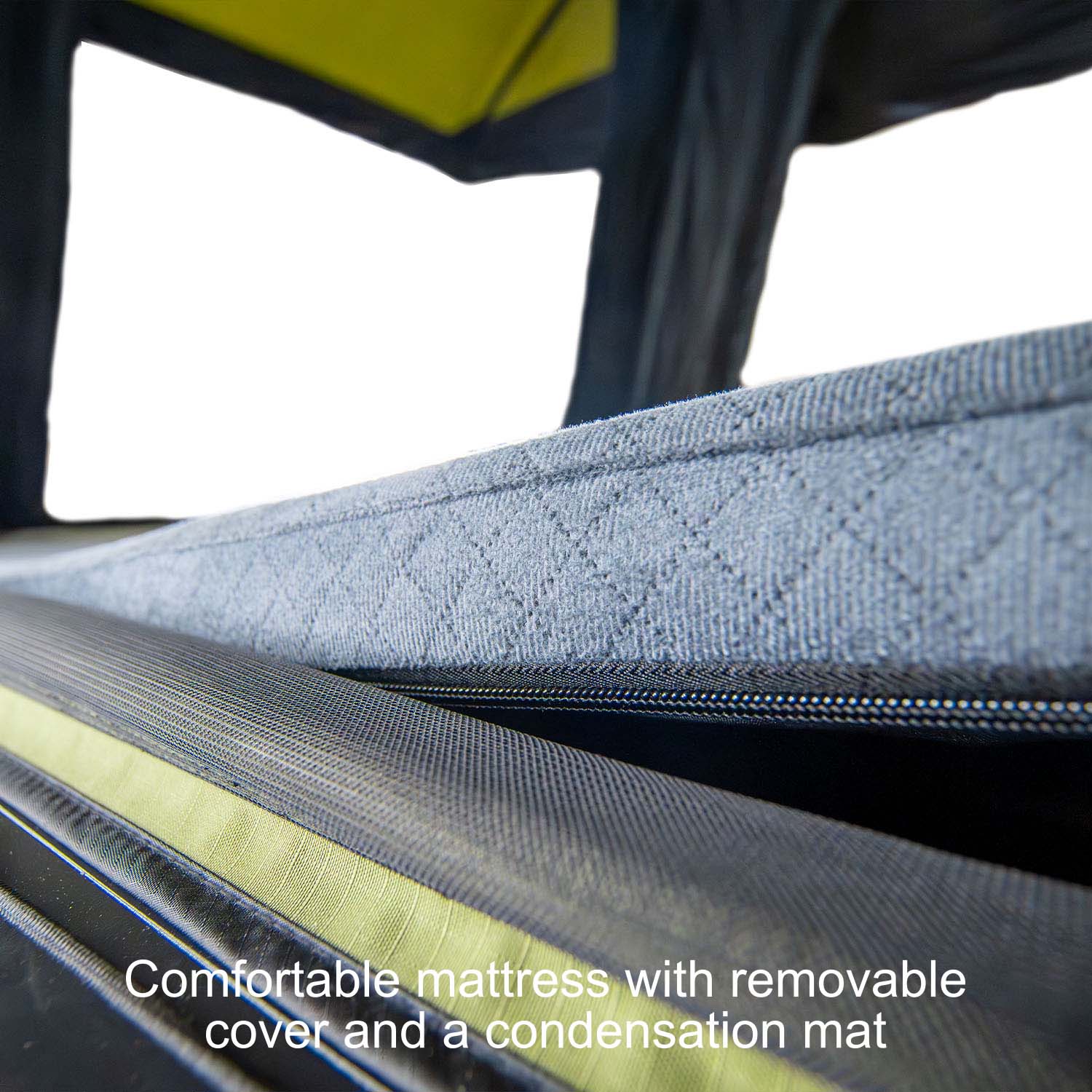
An anti-condensation mat is designed to create an air gap between the mattress and the floor or base of the rooftop tent.
That space serves an important purpose.
Instead of the mattress sitting directly against a cold surface with little opportunity for air movement, the mat creates channels through which air and moisture can move.
Improved airflow underneath the mattress can help moisture evaporate rather than remaining trapped against the mattress.
An anti-condensation mat can therefore be a useful part of a rooftop tent’s overall moisture-management system, especially for campers who frequently encounter cold or humid conditions.
But there’s an important distinction:
An anti-condensation mat does not stop your body from producing moisture, change the humidity outside, or prevent surfaces from reaching the dew point.
It helps manage moisture beneath the mattress.
That brings us to one of the biggest misconceptions surrounding tent condensation.



Is There Such a Thing as a Condensation-Proof Tent?
No tent can realistically guarantee that condensation will never occur.
Terms such as “condensation-proof tent” or “condensation-free tent” sound appealing, but condensation isn’t simply a defect that can be engineered out of every camping environment.
It’s a physical process.
If sufficiently humid air encounters a surface cold enough to reach or fall below its dew point, condensation can occur.
Tent construction can absolutely make a difference in how effectively moisture is managed. Ventilation, airflow, breathable materials, insulation, mattress ventilation and overall tent design can all influence the amount of condensation occupants experience.
But even an exceptionally well-designed tent cannot control every combination of temperature, humidity, weather, occupancy and camper behavior.
That’s why the better question isn’t:
“Which rooftop tent never gets condensation?”
It’s:
“How well does my rooftop tent allow me to manage moisture when condensation conditions occur?”
Understanding that distinction also helps prevent normal condensation from immediately being mistaken for a product failure.
Rooftop Tent Condensation vs. a Water Leak
Finding water inside your rooftop tent can understandably make you suspect a leak.
Condensation and water intrusion can sometimes look similar, but there are clues that can help you determine what’s happening.
| Signs of Condensation | Signs of a Possible Leak |
|---|---|
| Moisture appears across several interior surfaces | Water repeatedly appears in one localized area |
| Occurs during cold or humid nights | Commonly appears during or after rain |
| Can happen when there has been no precipitation | Moisture may correspond with external water exposure |
| Droplets form on walls, ceiling or windows | Water may follow a seam, opening or specific entry point |
| Moisture may appear underneath the mattress | Wetness may consistently originate from the same location |
| Often improves with better ventilation | May continue despite good ventilation |
This isn’t a definitive diagnostic test. Heavy condensation can collect and run down walls, creating localized wet areas, while some leaks can be difficult to trace because water travels before becoming visible.
If the inside of your tent becomes wet when it hasn’t rained, condensation should be one of the first possibilities you consider.
What Should You Do If Your Rooftop Tent Is Already Wet?
Sometimes condensation happens despite your best efforts.
Maybe temperatures dropped farther than expected. Maybe humidity was exceptionally high. Maybe you simply couldn’t provide enough ventilation because of the weather.
The important thing is what you do afterward.
Open and Ventilate the Tent
As soon as conditions permit, fully open the rooftop tent and increase airflow.
Open windows, doors and vents and allow humid interior air to escape.
Remove Standing Moisture
If droplets have accumulated on interior surfaces, wipe away excess water with a dry towel or absorbent cloth.
Removing the water manually gives the remaining moisture less work to do during the drying process.
Air Out Your Bedding
Sleeping bags, blankets and pillows can absorb moisture overnight even when they don’t feel obviously wet.
Pull them back, hang them up or remove them from the tent so air can circulate around them.
Lift the Mattress
Don’t only dry what you can see.
Lift the mattress and inspect the underside as well as the tent base. If either surface is damp, allow air to circulate underneath until both are dry.
An anti-condensation mat also needs an opportunity to dry if it has accumulated moisture.
Let the Tent Dry Before Long-Term Storage
Sometimes weather, travel plans or campsite checkout times mean you have to close a rooftop tent while it’s still damp.
If that happens, reopen it and dry it as soon as practical once conditions improve.
What you want to avoid is leaving a wet or damp tent packed away for an extended period.
Persistent moisture creates an environment where odors, mildew and mold can develop and can negatively affect tent materials and bedding over time.
If you had to pack up in the rain or close a damp tent before heading home, consider drying the tent part of unpacking from the trip rather than something to deal with later.
Can You Completely Prevent Tent Condensation?
Probably not.
And that’s worth emphasizing because some amount of condensation doesn’t automatically mean you’re doing something wrong or that something is wrong with your rooftop tent.
You can significantly reduce condensation by managing ventilation, airflow, wet gear and moisture beneath the mattress.
But you don’t control the weather.
A cold surface, sufficiently humid air and the right temperature differential can still produce condensation.
Rather than trying to achieve an impossible guarantee of zero moisture, focus on the things you can control:
- Maintain airflow.
- Use your tent’s ventilation.
- Reduce unnecessary moisture inside.
- Keep bedding as dry as possible.
- Check underneath the mattress.
- Use an anti-condensation mat where appropriate.
- Air out the tent after damp nights.
- Dry the tent thoroughly before extended storage.
Once you understand what’s causing tent condensation, it becomes much less mysterious.
That wet tent wall in the morning doesn’t necessarily mean your rooftop tent failed overnight. It may simply mean that warm, humid air met a cold surface.
Recognize the conditions, manage the moisture, give it somewhere to escape, and make drying your tent part of your camping routine when necessary.
Rooftop Tent Condensation FAQs
Tent condensation is common when warm, humid air inside a rooftop tent comes into contact with colder surfaces. These frequently asked questions explain why condensation happens, how to reduce it, how to manage moisture underneath your mattress, and when moisture may indicate something other than normal condensation.
Why does my tent get wet inside?
A tent can become wet inside when moisture in warm interior air condenses on colder surfaces. Breathing, perspiration, wet clothing, damp bedding, pets, and humid weather can all add moisture to the air. This means the inside of a tent can become wet from condensation even when it has not rained and there is no water leak.
Is tent condensation normal?
Yes. Tent condensation is a normal physical process that can occur in rooftop tents, ground tents, campers, and other enclosed sleeping spaces. It is especially common when humid interior air meets cold tent walls, windows, shells, or floors. Good ventilation and moisture management can reduce condensation, but they cannot guarantee that it will never occur.
How do I prevent condensation in a rooftop tent?
The best way to reduce rooftop tent condensation is to maintain airflow and limit unnecessary moisture inside the tent. Use available vents, partially open windows when conditions allow, create cross-ventilation, keep wet gear outside the sleeping area, air out damp bedding, and allow the tent to dry after humid or cold nights.
Why is tent condensation worse in cold weather?
Tent condensation is often more noticeable in cold weather because the walls, roof, windows, shell, and tent base become colder while occupants continue adding heat and moisture to the interior air. Closing every vent to retain warmth can also trap humid air inside, increasing the chance that moisture will condense on cold surfaces.
Should I leave my rooftop tent vents open at night?
When weather conditions allow, keeping vents open and maintaining some airflow can help reduce condensation. Cross-ventilation is particularly useful because it gives humid interior air a way to escape while allowing outside air to enter. The amount of ventilation needed will depend on temperature, wind, humidity, and weather conditions.
Why is there condensation under my rooftop tent mattress?
Moisture can form underneath a rooftop tent mattress when the warmer mattress and sleeping area sit above a cold tent base with limited airflow between them. Because this space may receive very little ventilation, moisture can remain trapped underneath the mattress. Periodically lifting the mattress and allowing the area to air out can help manage this moisture.
Does an anti-condensation mat stop tent condensation?
An anti-condensation mat can help reduce trapped moisture underneath a rooftop tent mattress by creating an air gap that improves ventilation. However, it does not eliminate the moisture produced by occupants or prevent condensation from forming elsewhere in the tent. It should be considered part of an overall moisture-management strategy rather than a complete cure.
How can I tell the difference between tent condensation and a leak?
Condensation often appears across multiple interior surfaces and can occur even when there has been no rain. A possible leak is more likely to repeatedly produce water in the same localized area during or after external water exposure. Because heavy condensation can also run down walls and collect in one location, inspect seams, fabric, zippers, and seals if water intrusion is suspected.
Can condensation cause mold in a rooftop tent?
Persistent moisture can create conditions that allow mold or mildew to develop, particularly if a rooftop tent, mattress, or bedding remains damp while packed away. Condensation itself does not mean mold will automatically develop. The important step is to remove excess moisture, air out the tent and mattress, and allow everything to dry thoroughly before extended storage.
Can you pack away a wet rooftop tent?
Sometimes weather or travel conditions make it necessary to close a rooftop tent while it is still damp. If that happens, reopen the tent and allow it, the mattress, and any damp bedding to dry as soon as practical. Avoid leaving a wet rooftop tent packed away for an extended period because trapped moisture can contribute to odors, mildew, mold, and material deterioration.
Is there such a thing as a condensation-proof tent?
No tent can realistically guarantee zero condensation in every environment. Ventilation, breathable materials, insulation, airflow, and anti-condensation systems can help manage moisture, but condensation can still occur whenever humid air encounters a surface cold enough for water vapor to condense. The goal is effective moisture management rather than a completely condensation-proof tent.
Final Thoughts: Managing Rooftop Tent Condensation
Tent condensation is a normal part of camping under the right environmental conditions, whether you’re sleeping in a traditional ground tent or a rooftop tent.
The key is understanding the difference between preventing water from entering your tent and managing moisture that already exists inside it.
Good ventilation, intentional airflow, dry bedding, responsible moisture management and airflow beneath the mattress can all reduce the amount of condensation you experience.
And when condensation does happen, don’t ignore it.
Air out the tent. Check underneath the mattress. Dry your bedding. Give moisture an opportunity to escape before the tent is stored for an extended period.
A rooftop tent can’t change the dew point or control the weather.
But understanding the conditions that cause condensation—and knowing how to respond to them—can help keep your tent, mattress and sleeping environment drier and more comfortable throughout your adventures.
Happy Camping!

Enjoyed This Post?
Discover more tips, gear guides, product reviews, and overlanding insights from the 23ZERO team.
Explore the Blog →